Wednesday, September 29, 2010

Etiquette in Society, in Business, in Politics and at Home by Emily Post


Everything, and I mean everything, you need to know about etiquette during this time period is in this book. I would STRONGLY recommend taking a look at it. It is organized into 38 different categories each focusing on the appropriate etiquette that should be used in any given situation from weddings to letter writing.

Here is the link:

Thursday, September 23, 2010

SNL Giraffes Video!!!!

Because Glenna told me to :)
Giraffes!!!!!!!!!!!!!!!!!!!!!!!!!!!!!!
http://www.hulu.com/watch/42614/saturday-night-live-giraffes

Social Register


Here is the link to the article Dennis mentioned in table work yesterday about the Social Register:

SS Normandie Video

SS Normandie Pictures


The French Line's Normandie is one of the relatively few legitimate contenders for the title "Greatest Liner Ever". She was a ship of superlatives: the largest ship in the world for five years, more than 20,000 tons larger than White Star's Majestic; the first liner to exceed 1000 feet in length; the first liner to exceed 60,000 tons (and 70,000 and 80,000, for that matter); the largest turbo-electric powered liner; and the first to make a 30 knot eastbound Atlantic crossing. All told, Normandie earned the Blue Riband for five record-breaking crossings; twice westbound and three times eastbound, including both legs of her maiden voyage. And yet, all these technical qualities are only part of Normandie's greatness; her design and decor were equally innovative, distinctive and luxurious. All of these factors contributed to her being described as "the ultimate ocean liner---definitely of the 1930s and possibly of the century"

(Braynard and Miller's Fifty Famous Liners.)


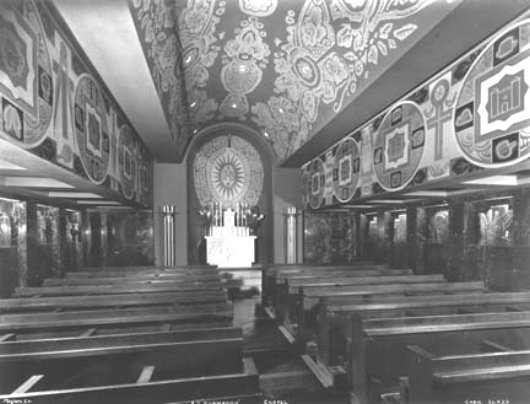
SS Normandie Interior


The luxurious interiors were designed in Art Deco and Streamline Moderne style. Many sculptures and wall paintings made allusions to Normandy, the province of France for which Normandie was named. Drawings and photographs show a series of vast public rooms of great elegance. Normandie's voluminous interior spaces were made possible by having the funnel intakes split to pass along the sides of the ship, rather than straight upward. French architect Roger-Henri Expert was in charge of the overall decorative scheme.

Most of the public space was devoted to first-class passengers, including the dining room, first-class lounge, grille room, first class swimming pool, theatre and winter garden. The first class swimming pool featured staggered depths, with a shallow training beach for children.

The interiors were filled with grand perspectives, spectacular entryways, and long, wide staircases. First-class suites were given unique designs by select designers. The most luxurious accommodations were the Deauville and Trouville apartments, featuring dining rooms, baby grand pianos, multiple bedrooms, and private decks. The first class dining hall was the largest room afloat. At three hundred and five feet (93 m) it was longer than the Hall of Mirrors at Versailles stood 46 feet (14 m) wide, and towered 28 feet (8.5 m) high. Passengers entered through 20-foot (6.1 m) tall doors adorned with bronze medallions by artist Raymond Subes. The room could seat 700 at 157 tables,with Normandie serving as a floating promotion for the most sophisricared French cuisine of the period. As no natural light could enter it was illuminated by 12 tall pillars of glass flanked by 38 matching columns along the walls. These, with chandeliers hung at each end of the room, earned the Normandie the nickname "Ship of Light"(similar to Paris as the '"City of Light").

A popular feature was the café grill, which would be transformed into a nightclub. Adjoining the cafe grill was the first class smoking room, which was paneled in large murals depicting ancient Egyptian life. Normandie also had indoor and outdoor pools, a chapel, and a theatre which could double as a stage and cinema.


SS Normandie Statistics

Owners

Compagnie Générale Transatlantique

Builders

Penhoët Shipyards, Saint Nazaire, France

Launched

October 29, 1932

Maiden voyage

May 29, 1935 Le Havre - New York

Broken up

October 3, 1946 to October 6, 1947

Length overall

1029 feet

Length between perpendiculars

962 feet

Beam

118 feet

Height from keel to top of first funnel

184 feet

Average loaded draft

37 feet

Gross registered tonnage

79,280 (83,423 after 1936)

Number of decks

12

Boilers

29 (plus 4 auxiliary)

Engines

Four Turbo-Electric, total 160,000 hp.

Cruising speed

29 knots.

Top speed

32.2 knots.

1st class passengers

848

2nd class passengers

670

3rd class passengers

54

Officers and crew

1345

Wednesday, September 22, 2010

Gavotte

You get the gist.


The Fatal Wedding/Southern Roses

The Fatal Wedding (Act II, pg.53)
Gussie Davis


Southern Roses (Act II, pg. 53)
Johann Strauss II


The origin of talking through one's hat

Here is the link to what we discussed in table work:

Meaning of character's names

Might be helpful, or just fun, to have a look at what your character's names mean:

First names:

Johnny-Short for "John". Hebrew for "God is gracious"

Julia-French for soft-haired, youthful

Linda-Spanish for "pretty one"/English for "Linden tree"

Edward-English for "wealthy guardian"

Ned-Short for Edward. See above.

Seton-Old English for "sea settlement"

Laura-English for "laurel-crowned"

Susan-Hebrew for "lily"

Nick-Short for Nicholas or Dominik. Meaning "victorious people"

Charles-German for "manly" or "farmer"

Delia-Could be short for Cordelia. Welsh for "dark"

Henry-German for "ruler of the home"


Last names:

Seton-Old English for "sea settlement"

Cram-German for "peddler"

Potter-English for "maker of pots"

Religion and Church in the Great Depression


For many in the 1930s, religion fueled their emotions and supported their arguments. For others, religion offered the solace of continuity and a sense of contact with something transcending the problems of this world, and many rejected mixing politics and religion.

The economic collapse had a direct effect on religious groups. Regular attendance at religious services dropped, perhaps because the recently poor were embarrassed by their new status. Only a third of the population reported attending services once a week.

While the Seton's do seem to be somewhat religious, particularly Edward, they would have also found an excuse to attend church so that they may flaunt their wealth. They could easily afford to wear their "Sunday Best" and give money to the church, unlike most Americans. America was also prominently white Protestant (we can assume that the Seton's are as well) and most thought that they were the most authentic Americans and exercised their cultural dominance.

Look familiar????


Maxfield Parrish's Work


Daybreak (Landscape) is regarded as the most popular art print of the 20th century, based on number of prints made: one for every four American homes.


Alberich (The Ring of Nibelung)


Old King Cole (Nursery Rhymes)


Dinky Bird (Poems of Childhood)


Sleeping Beauty (Myths and Fairy Tales)


The Fisherman and the Genie (Arabian Nights)

Maxfield Parrish's major works can be divided into six groups:
Arabian Nights (illustrations from 1909 and 1923), Myths and Fairy Tales, Poems of Childhood (illustrations from 1904), Nursery Rhymes, The Ring of Nibelung (illustrations from 1898) and Landscapes.

Selected Books Illustrated

  • Baum, L. Frank. Mother Goose in Prose. Chicago: Way & Williams, 1897.
  • Lee, Albert. The Knave of Hearts: A Fourth of July Comedietta. New York: Russel, 1897.
  • Grahame, Kenneth. The Golden Age. London: John Lane at Bodley Head, 1899.
  • Grahame, Kenneth. Dream Days. London: John Lane at Bodley Head, 1899.
  • Field, Eugene. Poems of Childhood. New York: Scribners, 1904.
  • Wharton, Edith. Italian Villas and Their Gardens. New York: Century, 1904.
  • Wiggin, Kate Douglas and Nora A. Smith, eds. The Arabian Nights, Their Best-Known Tales. New York: Scribners, 1909.
  • Hawthorne, Nathaniel. A Wonder Book and Tanglewood Tales for Girls and Boys. New York: Duffield, 1910.
  • Hawthorne, Hildegrade. Lure of the Garden. New York: Century, 1910.
  • Saunders, Louise. The Knave of Hearts. New York: Scribners, 1925.
  • Stein, Ealeen. Troubador Tales. Indianapolis: Bobbs-Merrill, 1929.

Periodicals Illustrated

  • Harper’s Weekly, 1895-1906.
  • Ladies’ Home Journal, 1896-1915, 1920, 1930-1931.
  • Scribner’s Magazine, 1897-1905.
  • Century, 1898-1917.
  • Collier’s, 1904-1913, 1936.

To see more go to:
http://maxfieldparrish.info/
http://parrish.artpassions.net/

Maxfield Parrish Biography


During the Golden Age of Illustration, Maxfield Parrish's "beautiful settings and charming figures" enchanted the American public. His work includes immense murals in office buildings and hotels, magazine covers, and advertisements as well as his book illustrations.

He was born Frederick Parrish in 1870 in Philadelphia, but he took the name Maxfield after his Quaker grandmother. His father, Stephen, was also an artist and Parrish's greatest influence. He originally studied architecture, an interest that is evident in his paintings. He attended Haverford College, the Pennylsvania Academy of Fine Arts and Drexel Institute of Arts. He married his wife Lydia 1895.

In 1900, Parrish contracted tuberculosis, and then suffered a nervous breakdown. Around that time, he switched from illustrations to oil painting. Parrish blue was named in acknowledgment. His oil paintings became very popular, with their brilliant colors and magical luminosity, until well into the 1940s. To achieve these magical effects, he would apply numerous layers of thin, transparent oil, alternating with varnish over stretched paper, a painstaking process that achieved both high luminosity and extraordinary detail. This is called glazing.

The tuberculosis hung on and Parrish went to Arizona to convalesce in the dry heat there. While in Arizona, he was commissioned to do a series of landscapes. He began painting and traveling on commission and his career took off.

Parrish worked at his home in Cornish, New Hampshire, called The Oaks. The Oaks was a popular destination for guests during the summers but in the frozen New Hampshire winters, Parrish dedicated himself to his painting.

In 1905, Parrish's met Susan Lewin, a 16-year old girl hired as a nanny for his son Dillwyn. Her image appears often in paintings from this time through the 1920s. Over time, Susan became Parrish's assistant, model for his paintings, and eventually his lover. His wife, Lydia, and Maxfield grew increasingly estranged and she left him in 1911. Susan stayed with Maxfield for another 50 years.

From the 1930s until 1960, when he stopped painting, Maxfield Parrish refocused his attention on the world around him, producing a series of calendar landscapes. Yet even these retain the magical, window-to-the-otherworld quality that permeates all of his work.

Parrish died at 95 in 1966, at a time when his work was enjoying a renaissance of interest.

Temperatures at Lake Placid and NYC

Lake Placid
Average temperature in 1935:
December 21/-4
(It did reach -30 at somepoint during the month.
Hopefully it wasn't when Julia and Johnny were there!)

New York City
Average temperature in 1935:
December 41 / 30
January 39 / 26


Julia is right! It was twenty degrees colder in Placid!

Fun Fact of the Day


Chocolate Crisp (later known as Kit Kat)

Did you know that many of America's most well-known sweets were introduced in the 20th century? Milky Way was introduced in 1923, Crunch in 1929, Snickers in 1930, Mars Bar in 1933 and the Kit Kat in 1935! Yum!

Dating in the 20th century

Dating, a new form of mixed-sex socializing, arose in the nation’s growing cities during the second decade of the twentieth century. It replaced earlier kinds of socializing that had been found in small towns and rural areas, both casual forms of mixing—such as church outings, picnics, sleigh rides, hay rides, and community dances—and also the formal process of calling, in which a young man paid a visit to a young woman’s house and was entertained in her parlor. Both casual mixing and calling were overseen by adults—by parents, kin, church members, and others in the community—and took place in mixed-age settings.

The word dating entered the American language during the 1910s. Dating was connected to the emergence of new kinds of commercial amusements, such as amusement parks, ice cream parlors, and especially the movies, and to the rise of the automobile. As early as the 1890s, young people in rapidly growing cities had begun to spend more of their leisure time in commercial settings, such as amusement parks, dance halls, and nickelodeons. By the 1910s, adolescent boys, in growing numbers, had begun to ask girls out. Starting in the 1920s, a date usually involved one or two couples going out together to a movie, a dance, a soda shop, or a roadside restaurant. In places outside of large cities, this increasingly relied on access to an automobile and became dependent on the outlay of significant amounts of cash to ensure that the treat for the afternoon or evening was acceptable to the dating partner. Commercial considerations were thus embedded into the very structure of the dating relationship, which required that the male treat the female to a good time. Women too were required to expend money on their appearance, wearing fashionable clothes and stylish hairdos, and relying on beauty treatments and up-to-date cosmetics.

Dating, unlike calling, was not about finding a mate. It was about having fun with a member of the opposite sex. At a time when gender relations were particularly distant, dating provided a way to bridge the gap
. Also unlike calling, which was monitored by adults, the dating system was overseen by young people themselves. The peer group set the rules for dating. Through gossip and teasing, it helped determine who one could go out with and how much sexual intimacy was allowed.

Dating was highly gendered. A boy was expected to ask a girl out, pay for the date, and provide the transportation. In return, he expected physical intimacy, In most cases, these activities fell short of intercourse, involving instead an elaborate pattern of sexual play that included hand-holding, kissing, petting, and fondling. It was well understood that within this evolving pattern women would define the limits of acceptable behavior, while men would try to push those boundaries as far as possible. Most studies of the 1920s and 1930s show that among those whose dating had become exclusive, especially those who were engaged to marry, intercourse would become an occasional or regular part of the dating relationship for about half of these couples. This was usually rationalized as a legitimate expression of the commitment to a long-lasting loving relationship oriented to marriage.

During the 1920s and 1930s, a young woman’s popularity was measured by how frequently she was asked out on dates. It was not uncommon for urban middle-class young women to go out on dates three or more times a week. Sociologists later discovered that those young women who dated the most were the least likely to pursue an advanced education and were especially likely to marry young.

A new vocabulary gradually appeared, including such words as crush, boyfriend, girlfriend, and going steady. An especially important word was “bashful,” to describe boys who were reluctant to date. By the 1930s, dating had become highly ritualized. Informal dating was followed by going steady (a new phrase during the Depression decade), getting pinned, getting engaged and then getting married.


Sources:
http://www.digitalhistory.uh.edu/do_history/courtship/flapper.html
http://www.faqs.org/childhood/Co-Fa/Dating.html

Education in the early 1900s


In the early 1900s, the wealthy children attended private academies. The schools were houses with a few rooms in them set aside for classrooms. They were small, with only about three or four pupils in each grade. One teacher taught several grades in just one room. In the private schools, girls and boys were not together. They went to separate academies. Some of the subjects the girls learned were reading, spelling, history, arithmetic, geography and penmanship or handwriting. Sometimes they learned manners and dancing, French, drawing and how to walk and act like a young lady.

The public schools, on the other hand, were free and mostly attended by the kids who were not rich. Boys and girls were at the same school. There was a class for each grade level with about 20 to 30 kids in each class. Most of the subjects were the same, but the teachers were harder on the children in public schools. If the kids did something wrong, the teachers would hit them with paddles or rulers, or box their ears. They also had lessons in archery and tennis, got to play basketball and learn how to swim.

In 1910, 79% of children were enrolled in American schools. In 1905 the average school term lasted 151 days, during which the average student attended 105 days. By 1918 all states had passed laws requiring children to attend at least elementary school. Most kids never finished the 8th grade. They went to work in factories, farms and coalmines to help their families. Some went to high school and a few went to college. At the beginning of the century about 2 percent of Americans from the ages of 18 to 24 were enrolled in a college. In those days, very few women went to college (about 1/3 of the pop. of college students) , especially since in America, there were only 11 colleges for women and it was difficult to accepted. Sometimes, if there was room in men's colleges, they would be accepted, but usually only in the summer when the men were working.

History of Women in America:
http://www.wic.org/misc/history.htm

The History of Education in America:
http://www.chesapeake.edu/Library/EDU_101/eduhist_20thC.asp